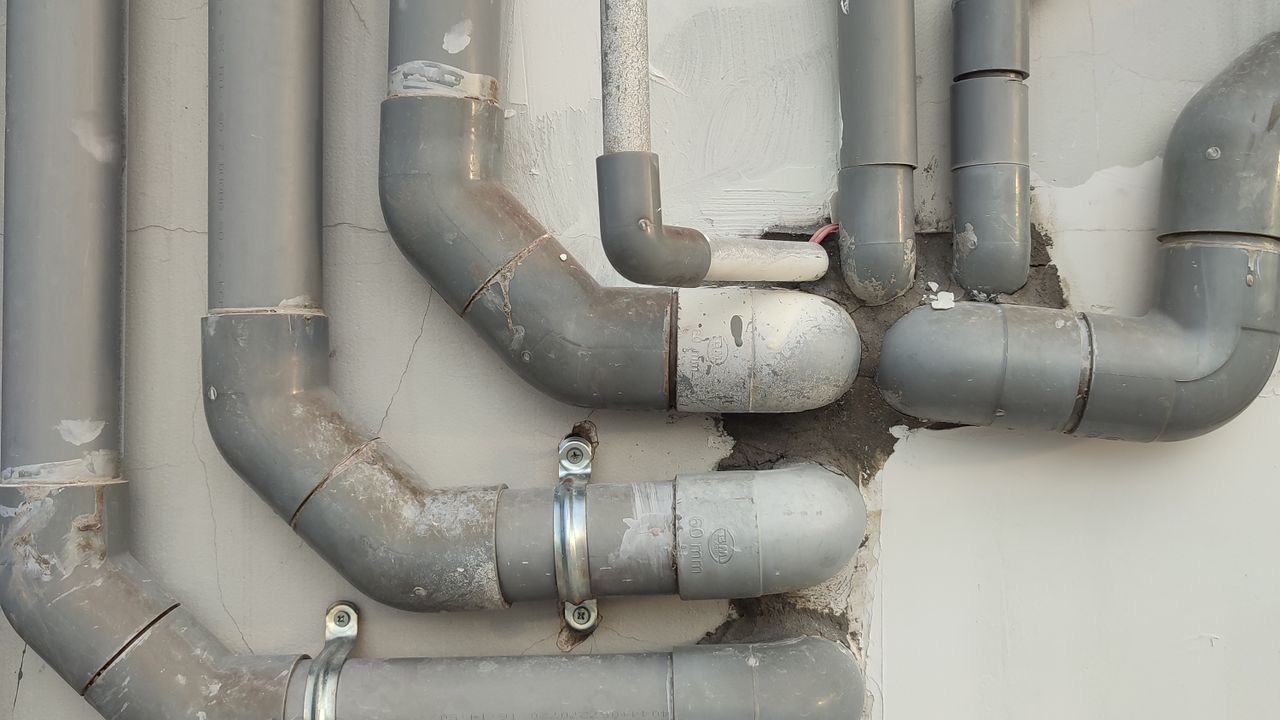
Schedule 40 is one of the most commonly referenced pipe specifications in industrial and commercial piping systems, and it’s also one of the more frequently misunderstood. The assumption that “Schedule 40” describes a fixed wall thickness leads to errors when switching materials within a piping system — because Schedule 40 in carbon steel, Schedule 40 in stainless steel, and Schedule 40 in PVC are not the same thickness for the same nominal size.
Understanding why this happens requires a brief look at where the Schedule system came from and what it was actually designed to specify.
The origin of the Schedule system
The pipe Schedule system was developed in the mid-twentieth century as a way to standardize the relationship between pipe nominal size, wall thickness, and working pressure. The original intent was that for a given pipe material and nominal size, the Schedule number would correspond to a specific working pressure capability. A higher Schedule number meant a thicker wall and a higher working pressure.
The formula underlying the original Schedule system is:
Schedule Number = (P / S) × 1000
Where P is the service pressure in psi and S is the allowable stress of the material in psi. For a given service pressure, a stronger material (higher allowable stress) would produce a lower Schedule number — meaning a thinner wall could handle the same pressure.
This is the key insight: the Schedule system was pressure-based, not geometry-based. Different materials with different strength properties produce different wall thicknesses for the same Schedule number and nominal pipe size — because the required wall thickness to achieve a given pressure rating depends on the material’s strength.
Carbon steel Schedule 40
Carbon steel pipe — ASTM A53 and A106 being the common grades — has an allowable stress in the range of 15,000–17,500 psi depending on grade and temperature. Schedule 40 wall thicknesses for carbon steel are the reference most piping engineers have in mind when they think of Schedule 40, because carbon steel is the default material for so many general industrial applications.
For a 4-inch (NPS 4) carbon steel pipe, Schedule 40 wall thickness is 0.237 inches (6.02mm). The outside diameter is 4.500 inches (114.3mm) for all schedules of NPS 4, which is a fixed dimension — the Schedule number only changes the wall, not the OD.
Stainless steel Schedule 40
Austenitic stainless steels (304, 316, and their variants) have higher allowable stress than carbon steel, which means a thinner wall can handle the same pressure. Per the original Schedule formula, achieving Schedule 40 pressure ratings with stainless steel requires less wall thickness.
However, the practical result in the market is more nuanced. ASTM A312 (seamless and welded austenitic stainless steel pipe) uses the same Schedule designations as carbon steel for the same nominal pipe sizes, and for most standard sizes Schedule 40 stainless steel has the same nominal wall thickness as Schedule 40 carbon steel. This is because the dimensional standards were harmonized to use consistent OD and wall dimensions across materials, even though the original pressure-rating logic would have justified thinner walls for stainless.
Where the difference appears is in smaller pipe sizes and in the specific relationship between Schedules. For small-diameter stainless steel pipe, Schedule 40S (the “S” suffix indicating the stainless steel series) may differ from plain Schedule 40. The “S” schedules were introduced specifically for stainless to align with ASME B36.19 (stainless steel pipe dimensions) rather than ASME B36.10 (welded and seamless wrought steel pipe, the carbon steel standard).
For NPS sizes up to 12 inches, Schedule 40 and Schedule 40S have the same wall thickness. For larger sizes, the S schedules diverge. When ordering stainless pipe, specifying “Schedule 40S per ASME B36.19” rather than just “Schedule 40” avoids ambiguity, particularly for larger diameters.
PVC Schedule 40
PVC is a thermoplastic with substantially different mechanical properties from steel. Its allowable stress is much lower — roughly 2,000 psi for PVC at room temperature, compared to 15,000+ psi for steel. Per the original Schedule formula, the lower allowable stress requires a thicker wall to achieve the same pressure rating.
As a result, PVC Schedule 40 pipe has significantly thicker walls than steel Schedule 40 pipe of the same nominal size. For NPS 4 PVC Schedule 40, the wall thickness is approximately 0.337 inches (8.56mm), compared to 0.237 inches (6.02mm) for steel NPS 4 Schedule 40 — about 42% thicker.
This has practical consequences. A PVC Schedule 40 system can handle the same working pressure as a steel Schedule 40 system despite PVC being a weaker material, because the thicker wall compensates. But the thicker wall also means different weight, different support spacing requirements, and different fitting dimensions. PVC Schedule 40 fittings are dimensioned to match PVC Schedule 40 pipe — not carbon steel Schedule 40 pipe.
The outside diameter: the constant across materials
Despite the wall thickness differences, the outside diameter of Schedule 40 pipe is the same for all materials at a given nominal size. NPS 4 pipe — whether carbon steel, stainless steel, or PVC — has an OD of 4.500 inches. This is by design: the NPS system standardizes OD so that fittings, flanges, and connections can be dimensioned to a consistent reference.
The inside diameter varies with the wall thickness. NPS 4 carbon steel Schedule 40 (wall 0.237”) has an ID of approximately 4.026”. NPS 4 PVC Schedule 40 (wall 0.337”) has an ID of approximately 3.826”. The flow area difference is not trivial — a thicker-walled pipe has a smaller bore and higher velocity for the same flow rate.
When replacing a section of carbon steel Schedule 40 with PVC Schedule 40 in an existing system, the fittings (flanges, couplings, threadolets) sized for steel OD will fit the PVC pipe, but the flow area is now slightly reduced at the PVC section. In most applications this is irrelevant, but in flow-sensitive systems it’s worth noting.
CPVC and HDPE: the same pattern, different numbers
CPVC (chlorinated PVC) and HDPE (high-density polyethylene) follow the same logic. CPVC has slightly higher allowable stress than standard PVC, so CPVC Schedule 40 wall thicknesses are slightly thinner than PVC Schedule 40 at some sizes, while still thicker than steel. HDPE is typically specified by a different system (SDR — Standard Dimension Ratio) rather than Schedule, because HDPE’s pressure performance scales with wall thickness ratio rather than absolute thickness in the same way Schedule was designed for metal pipe.
Using a Schedule 40 pipe thickness chart correctly
A Schedule 40 pipe thickness chart is most useful when it specifies the material alongside the Schedule and nominal size. A chart that lists only Schedule 40 dimensions without specifying the material standard is incomplete — it’s showing you dimensions for one material (typically carbon steel, as the default) that don’t automatically apply to stainless steel at larger sizes or to plastic pipe at any size.
When working across materials, the correct approach is:
- For carbon steel: reference ASME B36.10, which lists Schedule 40 dimensions
- For stainless steel: reference ASME B36.19, which lists Schedule 40S dimensions (identical to Schedule 40 for NPS ½ through 12”, but diverges for larger sizes)
- For PVC: reference ASTM D1785, which lists Schedule 40 PVC dimensions
- For CPVC: reference ASTM F441, which covers CPVC Schedule 40 and 80 dimensions
The standards confirm what the dimensions are. The material properties — allowable stress, temperature rating, chemical compatibility — determine whether those dimensions are appropriate for the service conditions.
The practical implication for mixed-material systems
Many process piping systems use carbon steel for high-temperature or high-pressure sections and transition to plastic (PVC, CPVC, or HDPE) for corrosive services or lower-pressure branches. Where these transitions happen, verifying that the fitting dimensions account for the wall thickness difference between the carbon steel and plastic sections prevents installation errors. Most transition fittings (threaded steel-to-plastic adapters, flanged transitions) are designed around OD compatibility, which works because OD is consistent. The ID difference is managed at the flow calculation stage, not the mechanical connection stage.
Understanding that Schedule 40 is a pressure-capacity specification, not a dimensional one, is what makes this cross-material work tractable. The number describes a design intent; the material determines how thick the wall needs to be to fulfill it.